User Experience Research and Design for my Project
SICK.SHOES
-
Introduction
Shoes are rarely just shoes. They carry stories of identity, creativity, rebellion, and belonging. From basketball courts and music stages to art galleries and everyday streets, iconic footwear has consistently played a role in shaping culture. My major project, SICK.SHOES, is built around this idea. It is a proposed web-based platform that explores the intersection of footwear, art, and music through immersive digital storytelling.
Rather than presenting shoes as commercial products, SICK.SHOES treats them as cultural artefacts. Each featured shoe becomes the starting point for a deeper narrative that explores its design process, artistic influences, technological innovation, and emotional impact. The aim is to create an experience that feels more like entering a digital exhibition than browsing a fashion website.
At the core of this project is User Experience Research and Design. By grounding creative decisions in UX principles, I want to ensure that the platform feels intuitive, accessible, and emotionally engaging. Visuals, sound, and interaction are carefully designed to work together, guiding users naturally through each story without overwhelming them.
This document outlines my full UX research and design process, from early domain research and user analysis to information architecture, prototyping, usability testing, and iteration. It demonstrates how research-led design can support both creativity and usability, resulting in a meaningful and human-centred digital experience.Initial Research Phase
Understanding the Domain
Before designing any interface or interaction, it was essential to understand the cultural context surrounding footwear. Shoes, particularly sneakers, often exist at the crossroads of sport, music, fashion, and social identity. My initial research focused on tracing how iconic shoes have appeared in films, album artwork, street culture, and contemporary art, and how they reflect wider social and cultural shifts.
For example, shoes like the Air Jordan 1 or the Adidas Superstar are deeply connected to moments in music, sport, and youth culture. They represent confidence, resistance, creativity, and community. Understanding these narratives helped me realise that SICK.SHOES should not function as a catalogue or review site. Instead, it should act as a digital storytelling space that celebrates meaning and context.
This research also helped define the tone of the project. Rather than being promotional or sales-driven, the platform aims to be reflective, expressive, and culturally informed. By grounding the design in research, I can ensure that the experience feels authentic rather than superficial.
Competitive Analysis
To understand how SICK.SHOES might fit into the existing digital landscape, I conducted a competitive analysis of platforms that focus on fashion storytelling, creative archives, or multimedia experiences. This included fashion brand websites, online magazines, digital exhibitions, and experimental storytelling platforms.
During this analysis, I focused on several key areas. I examined how different platforms combine text, imagery, video, and sound, how they structure navigation and content discovery, and how accessible and inclusive their designs are. I also paid attention to emotional tone, looking at whether these platforms felt inspiring, overwhelming, or overly commercial.- One of the key insights from this process was that many fashion platforms prioritise visual impact but often neglect deeper storytelling or emotional pacing. Music is rarely integrated in a meaningful way, and when it is, it often feels disconnected from the visual experience. This revealed a clear opportunity for SICK.SHOES to stand out by treating music and visuals as equal narrative tools rather than decorative elements.
Defining Users Through PersonasIdentifying Target Audiences
Based on my research and workshop insights, I identified three primary audience groups for SICK.SHOES.
- The first group is fashion enthusiasts aged 18 to 30. These users are active on social media, follow fashion trends and influencers, and seek inspiration rather than in-depth technical analysis. They are visually driven and enjoy discovering new creative ideas.
- The second group is art and design lovers aged 20 to 40. This group includes students, creatives, and professionals who are interested in how different disciplines intersect. They value storytelling, concept, and process, and are likely to appreciate thoughtful design and cultural context.
- The third group is sneaker collectors aged 25 to 45. These users see footwear as heritage objects and collectibles. They value authenticity, history, and craftsmanship, and are often frustrated by platforms that reduce shoes to hype or resale value.
Together, these groups represent a diverse but overlapping audience, united by an interest in creativity and culture.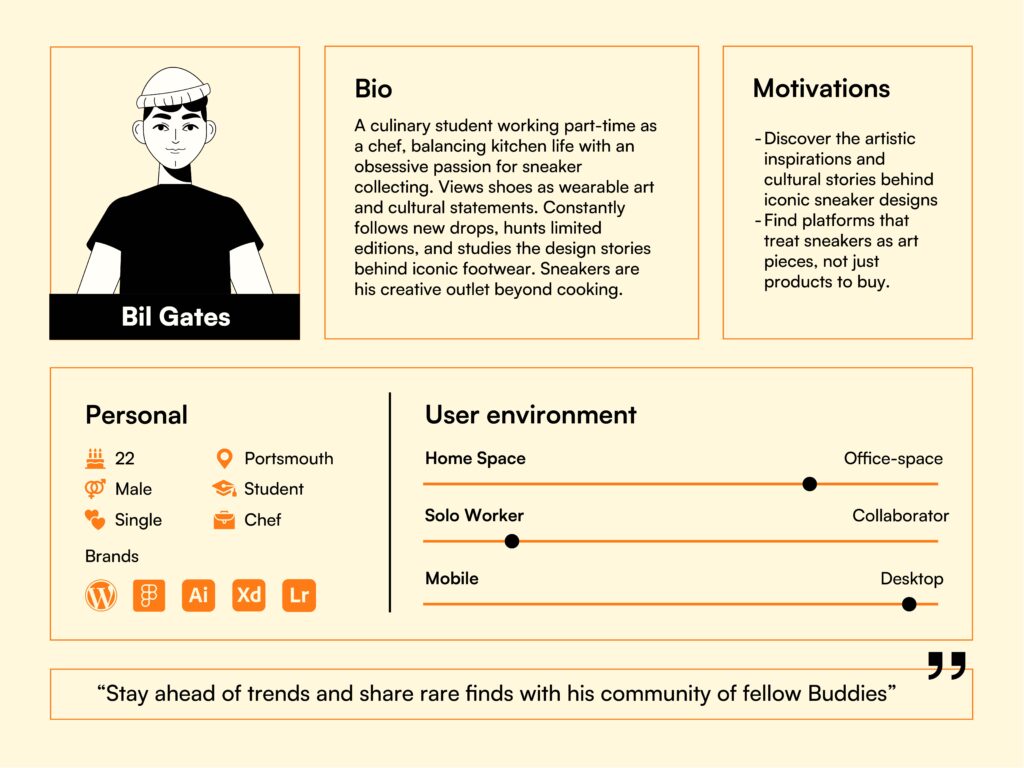

Creating Persona DocumentsTo keep these users at the centre of my design process, I will create detailed persona documents for each group. These personas will include demographic information, goals, frustrations, motivations, behaviours, and preferred digital platforms.
Each persona will be presented visually in a PDF format, making them easy to reference throughout the project. They will act as constant reminders that every design decision should serve a real user need. During presentations and critiques, I will use these personas to justify design choices, ensuring that features are grounded in research rather than personal preference.
Empathy MappingUnderstanding User Emotions
While personas define who the users are, empathy mapping helps uncover how they feel when engaging with creative digital content. This step encourages deeper reflection on users’ thoughts, emotions, and frustrations.
Through empathy mapping, I explored questions such as what users feel when exploring fashion stories online, what frustrates them about existing platforms, and what moments make them feel emotionally connected. Many users feel inspired by fashion storytelling but also overwhelmed by cluttered interfaces, intrusive advertising, or overly complex navigation.- Think & Feel: What matters to users when exploring fashion content? What emotions do they experience when discovering the story behind a beloved shoe design?
- Pain Points: What frustrates them about current fashion platforms? What gaps exist in storytelling about footwear?


Application to SICK.SHOESThese insights strongly influenced my design intentions. Users want to feel guided rather than bombarded. They want space to reflect and engage emotionally, without being pushed toward consumption. As a result, SICK.SHOES is designed to unfold slowly, using pacing, whitespace, and smooth transitions to support discovery.
Empathy mapping helped shape the tone of the experience. The platform aims to feel calm, immersive, and respectful of the user’s attention. Storytelling is prioritised over promotion, allowing users to form their own emotional connections with each shoe.
User Journey MappingVisualising the Experience
User journey mapping allowed me to visualise how different personas might move through the platform over time. By mapping these journeys, I could identify moments of excitement, confusion, or frustration.
I developed three core journeys.- The first is the first-time visitor, who lands on the homepage and needs to quickly understand what SICK.SHOES is and how to explore it.
- The second is the returning user, who visits regularly to experience new featured stories.
- The third is the deep explorer, who dives into archived content and spends extended time engaging with narratives.
Mapping these journeys helped highlight key touchpoints where design clarity and emotional impact are most important. For example, the transition from the homepage into a story needs to feel seamless and inviting.
Information ArchitectureA clear and intuitive structure is essential for a content-rich platform. Based on journey mapping insights, I designed an information architecture that balances featured content with exploratory browsing.
Card Sorting ExerciseTo validate this structure, I plan to conduct a card sorting exercise with participants who align with my personas. They will organise content categories based on what feels logical and intuitive to them.
This process will reveal how users naturally group content such as music, design insights, and cultural background. Their feedback will inform refinements to navigation labels and page hierarchy, ensuring that the platform aligns with real user expectations rather than assumed logic.
Wireframing and PrototypingWireframes
Low-fidelity wireframes will be created in Figma to establish layout, hierarchy, and flow. At this stage, the focus is on usability rather than aesthetics. I will wireframe key pages such as the landing page, featured story layout, archive view, and navigation components.
These wireframes will allow me to test content flow and interaction logic early, reducing the risk of usability issues later in development.

PrototypesOnce wireframes are refined, I will create interactive prototypes that simulate real user interactions. These prototypes will demonstrate scrolling narratives, transitions, and audio-visual synchronisation.
Prototyping allows me to test how music and visuals work together in practice. It also provides a realistic environment for usability testing, helping identify issues before any code is written.
Usability Testing Strategy
Planning Test SessionsUsability testing is a critical step in validating design decisions. I plan to recruit between two and five participants representing my personas. Each participant will complete tasks such as finding the featured shoe, exploring its story, interacting with audio elements, and navigating the archive.
My testing approach will include:
• Recruitment: Selecting 2-5 participants who match the persona profiles, ensuring diversity in technical skill levels and familiarity with fashion content
• Task Scenarios: Creating realistic scenarios like discovering the featured shoe, exploring design inspirations, finding a specific shoe in the archive, and sharing content
• Think-Aloud Protocol: Asking participants to verbalize their thoughts while navigating the prototype
• Observation: Taking detailed notes on where users hesitate, what they find confusing, and what delights them
Testing Focus Areas•Navigation Clarity: Can users easily understand how to move through the story? Is the scrolling interaction intuitive?
• Content Comprehension: Do users understand the shoe’s story and its cultural significance? Is the information organized logically?
• Emotional Response: Does the platform evoke the intended emotional connection? Do users feel engaged by the storytelling?
• Accessibility: Can users with different abilities access and enjoy the content? Are keyboard navigation and screen readers supported?
Accessibility and Inclusion
Designing for All UsersAccessibility is not an afterthought in this project. From the beginning, SICK.SHOES is designed to be inclusive. Visual accessibility will be supported through high contrast, scalable text, and thoughtful colour choices. Audio content will be accompanied by transcripts and captions, ensuring that stories remain accessible without sound.
Keyboard navigation, clear structure, and predictable interactions will support motor and cognitive accessibility. Importantly, inclusivity is treated as a creative strength rather than a limitation, ensuring that all users can engage meaningfully with the platform.
Iteration and RefinementDesign is an ongoing process. Feedback from usability testing and peer critique will be analysed and categorised into critical fixes, quality improvements, and creative opportunities. This structured approach ensures that essential issues are resolved first, while also leaving room for experimentation and future development.
Ethical and Analytical ConsiderationsAlthough the project will not launch publicly during assessment, it is designed with ethical analytics in mind. Tools such as scroll depth and interaction heatmaps could be used in the future to understand engagement patterns without compromising user privacy. These insights would support long-term improvement grounded in real user behaviour.
ConclusionThrough the workshop sessions, I have come to understand that effective user experience design is grounded in empathy, supported by research, and strengthened through continuous iteration and inclusive practice. Each method discussed within this document contributes to a shared objective: to design a digital space in which footwear is reimagined as a carrier of cultural meaning rather than a purely functional object. SICK.SHOES seeks to demonstrate that carefully considered UX design can transform familiar, everyday items into rich narrative experiences within a digital environment. By engaging in comprehensive research, developing user personas, producing empathy maps, visualising user journeys, constructing prototypes, and testing these designs with real users, I aim to ensure that the platform moves beyond visual appeal to genuinely address the expectations and emotional needs of its audience.
As I progress through my Major Project, this framework will act as both a practical guide and a critical reference point, supporting informed decision making throughout the design and development process. The materials produced during this phase will not only shape the final outcome but will also evidence a structured and reflective approach to user-centred design. Ultimately, the project aims to demonstrate a confident and applied understanding of UX research methodologies, showing how they can be effectively translated into a functional and engaging web platform. SICK.SHOES will stand as an example of how user-centred design principles can be used to create meaningful digital experiences at the intersection of fashion, art, and music. -
Introduction
Shoes are rarely just shoes. They carry stories of identity, creativity, rebellion, and belonging. From basketball courts and music stages to art galleries and everyday streets, iconic footwear has consistently played a role in shaping culture. My major project, SICK.SHOES, is built around this idea. It is a proposed web-based platform that explores the intersection of footwear, art, and music through immersive digital storytelling.
Rather than presenting shoes as commercial products, SICK.SHOES treats them as cultural artefacts. Each featured shoe becomes the starting point for a deeper narrative that explores its design process, artistic influences, technological innovation, and emotional impact. The aim is to create an experience that feels more like entering a digital exhibition than browsing a fashion website.
At the core of this project is User Experience Research and Design. By grounding creative decisions in UX principles, I want to ensure that the platform feels intuitive, accessible, and emotionally engaging. Visuals, sound, and interaction are carefully designed to work together, guiding users naturally through each story without overwhelming them.
This document outlines my full UX research and design process, from early domain research and user analysis to information architecture, prototyping, usability testing, and iteration. It demonstrates how research-led design can support both creativity and usability, resulting in a meaningful and human-centred digital experience.Initial Research Phase
Understanding the Domain
Before designing any interface or interaction, it was essential to understand the cultural context surrounding footwear. Shoes, particularly sneakers, often exist at the crossroads of sport, music, fashion, and social identity. My initial research focused on tracing how iconic shoes have appeared in films, album artwork, street culture, and contemporary art, and how they reflect wider social and cultural shifts.
For example, shoes like the Air Jordan 1 or the Adidas Superstar are deeply connected to moments in music, sport, and youth culture. They represent confidence, resistance, creativity, and community. Understanding these narratives helped me realise that SICK.SHOES should not function as a catalogue or review site. Instead, it should act as a digital storytelling space that celebrates meaning and context.
This research also helped define the tone of the project. Rather than being promotional or sales-driven, the platform aims to be reflective, expressive, and culturally informed. By grounding the design in research, I can ensure that the experience feels authentic rather than superficial.
Competitive Analysis
To understand how SICK.SHOES might fit into the existing digital landscape, I conducted a competitive analysis of platforms that focus on fashion storytelling, creative archives, or multimedia experiences. This included fashion brand websites, online magazines, digital exhibitions, and experimental storytelling platforms.
During this analysis, I focused on several key areas. I examined how different platforms combine text, imagery, video, and sound, how they structure navigation and content discovery, and how accessible and inclusive their designs are. I also paid attention to emotional tone, looking at whether these platforms felt inspiring, overwhelming, or overly commercial.- One of the key insights from this process was that many fashion platforms prioritise visual impact but often neglect deeper storytelling or emotional pacing. Music is rarely integrated in a meaningful way, and when it is, it often feels disconnected from the visual experience. This revealed a clear opportunity for SICK.SHOES to stand out by treating music and visuals as equal narrative tools rather than decorative elements.
Defining Users Through PersonasIdentifying Target Audiences
Based on my research and workshop insights, I identified three primary audience groups for SICK.SHOES.
- The first group is fashion enthusiasts aged 18 to 30. These users are active on social media, follow fashion trends and influencers, and seek inspiration rather than in-depth technical analysis. They are visually driven and enjoy discovering new creative ideas.
- The second group is art and design lovers aged 20 to 40. This group includes students, creatives, and professionals who are interested in how different disciplines intersect. They value storytelling, concept, and process, and are likely to appreciate thoughtful design and cultural context.
- The third group is sneaker collectors aged 25 to 45. These users see footwear as heritage objects and collectibles. They value authenticity, history, and craftsmanship, and are often frustrated by platforms that reduce shoes to hype or resale value.
Together, these groups represent a diverse but overlapping audience, united by an interest in creativity and culture.
Creating Persona DocumentsTo keep these users at the centre of my design process, I will create detailed persona documents for each group. These personas will include demographic information, goals, frustrations, motivations, behaviours, and preferred digital platforms.
Each persona will be presented visually in a PDF format, making them easy to reference throughout the project. They will act as constant reminders that every design decision should serve a real user need. During presentations and critiques, I will use these personas to justify design choices, ensuring that features are grounded in research rather than personal preference.
Empathy MappingUnderstanding User Emotions
While personas define who the users are, empathy mapping helps uncover how they feel when engaging with creative digital content. This step encourages deeper reflection on users’ thoughts, emotions, and frustrations.
Through empathy mapping, I explored questions such as what users feel when exploring fashion stories online, what frustrates them about existing platforms, and what moments make them feel emotionally connected. Many users feel inspired by fashion storytelling but also overwhelmed by cluttered interfaces, intrusive advertising, or overly complex navigation.- Think & Feel: What matters to users when exploring fashion content? What emotions do they experience when discovering the story behind a beloved shoe design?
- Pain Points: What frustrates them about current fashion platforms? What gaps exist in storytelling about footwear?
Application to SICK.SHOESThese insights strongly influenced my design intentions. Users want to feel guided rather than bombarded. They want space to reflect and engage emotionally, without being pushed toward consumption. As a result, SICK.SHOES is designed to unfold slowly, using pacing, whitespace, and smooth transitions to support discovery.
Empathy mapping helped shape the tone of the experience. The platform aims to feel calm, immersive, and respectful of the user’s attention. Storytelling is prioritised over promotion, allowing users to form their own emotional connections with each shoe.
User Journey MappingVisualising the Experience
User journey mapping allowed me to visualise how different personas might move through the platform over time. By mapping these journeys, I could identify moments of excitement, confusion, or frustration.
I developed three core journeys.- The first is the first-time visitor, who lands on the homepage and needs to quickly understand what SICK.SHOES is and how to explore it.
- The second is the returning user, who visits regularly to experience new featured stories.
- The third is the deep explorer, who dives into archived content and spends extended time engaging with narratives.
Mapping these journeys helped highlight key touchpoints where design clarity and emotional impact are most important. For example, the transition from the homepage into a story needs to feel seamless and inviting.
Information ArchitectureA clear and intuitive structure is essential for a content-rich platform. Based on journey mapping insights, I designed an information architecture that balances featured content with exploratory browsing.
Card Sorting ExerciseTo validate this structure, I plan to conduct a card sorting exercise with participants who align with my personas. They will organise content categories based on what feels logical and intuitive to them.
This process will reveal how users naturally group content such as music, design insights, and cultural background. Their feedback will inform refinements to navigation labels and page hierarchy, ensuring that the platform aligns with real user expectations rather than assumed logic.
Wireframing and PrototypingWireframes
Low-fidelity wireframes will be created in Figma to establish layout, hierarchy, and flow. At this stage, the focus is on usability rather than aesthetics. I will wireframe key pages such as the landing page, featured story layout, archive view, and navigation components.
These wireframes will allow me to test content flow and interaction logic early, reducing the risk of usability issues later in development.
PrototypesOnce wireframes are refined, I will create interactive prototypes that simulate real user interactions. These prototypes will demonstrate scrolling narratives, transitions, and audio-visual synchronisation.
Prototyping allows me to test how music and visuals work together in practice. It also provides a realistic environment for usability testing, helping identify issues before any code is written.
Usability Testing Strategy
Planning Test SessionsUsability testing is a critical step in validating design decisions. I plan to recruit between two and five participants representing my personas. Each participant will complete tasks such as finding the featured shoe, exploring its story, interacting with audio elements, and navigating the archive.
My testing approach will include:
• Recruitment: Selecting 2-5 participants who match the persona profiles, ensuring diversity in technical skill levels and familiarity with fashion content
• Task Scenarios: Creating realistic scenarios like discovering the featured shoe, exploring design inspirations, finding a specific shoe in the archive, and sharing content
• Think-Aloud Protocol: Asking participants to verbalize their thoughts while navigating the prototype
• Observation: Taking detailed notes on where users hesitate, what they find confusing, and what delights them
Testing Focus Areas•Navigation Clarity: Can users easily understand how to move through the story? Is the scrolling interaction intuitive?
• Content Comprehension: Do users understand the shoe’s story and its cultural significance? Is the information organized logically?
• Emotional Response: Does the platform evoke the intended emotional connection? Do users feel engaged by the storytelling?
• Accessibility: Can users with different abilities access and enjoy the content? Are keyboard navigation and screen readers supported?
Accessibility and Inclusion
Designing for All UsersAccessibility is not an afterthought in this project. From the beginning, SICK.SHOES is designed to be inclusive. Visual accessibility will be supported through high contrast, scalable text, and thoughtful colour choices. Audio content will be accompanied by transcripts and captions, ensuring that stories remain accessible without sound.
Keyboard navigation, clear structure, and predictable interactions will support motor and cognitive accessibility. Importantly, inclusivity is treated as a creative strength rather than a limitation, ensuring that all users can engage meaningfully with the platform.
Iteration and RefinementDesign is an ongoing process. Feedback from usability testing and peer critique will be analysed and categorised into critical fixes, quality improvements, and creative opportunities. This structured approach ensures that essential issues are resolved first, while also leaving room for experimentation and future development.
Ethical and Analytical ConsiderationsAlthough the project will not launch publicly during assessment, it is designed with ethical analytics in mind. Tools such as scroll depth and interaction heatmaps could be used in the future to understand engagement patterns without compromising user privacy. These insights would support long-term improvement grounded in real user behaviour.
ConclusionThrough the workshop sessions, I have come to understand that effective user experience design is grounded in empathy, supported by research, and strengthened through continuous iteration and inclusive practice. Each method discussed within this document contributes to a shared objective: to design a digital space in which footwear is reimagined as a carrier of cultural meaning rather than a purely functional object. SICK.SHOES seeks to demonstrate that carefully considered UX design can transform familiar, everyday items into rich narrative experiences within a digital environment. By engaging in comprehensive research, developing user personas, producing empathy maps, visualising user journeys, constructing prototypes, and testing these designs with real users, I aim to ensure that the platform moves beyond visual appeal to genuinely address the expectations and emotional needs of its audience.
As I progress through my Major Project, this framework will act as both a practical guide and a critical reference point, supporting informed decision making throughout the design and development process. The materials produced during this phase will not only shape the final outcome but will also evidence a structured and reflective approach to user-centred design. Ultimately, the project aims to demonstrate a confident and applied understanding of UX research methodologies, showing how they can be effectively translated into a functional and engaging web platform. SICK.SHOES will stand as an example of how user-centred design principles can be used to create meaningful digital experiences at the intersection of fashion, art, and music. -
Introduction
Shoes are rarely just shoes. They carry stories of identity, creativity, rebellion, and belonging. From basketball courts and music stages to art galleries and everyday streets, iconic footwear has consistently played a role in shaping culture. My major project, SICK.SHOES, is built around this idea. It is a proposed web-based platform that explores the intersection of footwear, art, and music through immersive digital storytelling.
Rather than presenting shoes as commercial products, SICK.SHOES treats them as cultural artefacts. Each featured shoe becomes the starting point for a deeper narrative that explores its design process, artistic influences, technological innovation, and emotional impact. The aim is to create an experience that feels more like entering a digital exhibition than browsing a fashion website.
At the core of this project is User Experience Research and Design. By grounding creative decisions in UX principles, I want to ensure that the platform feels intuitive, accessible, and emotionally engaging. Visuals, sound, and interaction are carefully designed to work together, guiding users naturally through each story without overwhelming them.
This document outlines my full UX research and design process, from early domain research and user analysis to information architecture, prototyping, usability testing, and iteration. It demonstrates how research-led design can support both creativity and usability, resulting in a meaningful and human-centred digital experience.Initial Research Phase
Understanding the Domain
Before designing any interface or interaction, it was essential to understand the cultural context surrounding footwear. Shoes, particularly sneakers, often exist at the crossroads of sport, music, fashion, and social identity. My initial research focused on tracing how iconic shoes have appeared in films, album artwork, street culture, and contemporary art, and how they reflect wider social and cultural shifts.
For example, shoes like the Air Jordan 1 or the Adidas Superstar are deeply connected to moments in music, sport, and youth culture. They represent confidence, resistance, creativity, and community. Understanding these narratives helped me realise that SICK.SHOES should not function as a catalogue or review site. Instead, it should act as a digital storytelling space that celebrates meaning and context.
This research also helped define the tone of the project. Rather than being promotional or sales-driven, the platform aims to be reflective, expressive, and culturally informed. By grounding the design in research, I can ensure that the experience feels authentic rather than superficial.
Competitive Analysis
To understand how SICK.SHOES might fit into the existing digital landscape, I conducted a competitive analysis of platforms that focus on fashion storytelling, creative archives, or multimedia experiences. This included fashion brand websites, online magazines, digital exhibitions, and experimental storytelling platforms.
During this analysis, I focused on several key areas. I examined how different platforms combine text, imagery, video, and sound, how they structure navigation and content discovery, and how accessible and inclusive their designs are. I also paid attention to emotional tone, looking at whether these platforms felt inspiring, overwhelming, or overly commercial.- One of the key insights from this process was that many fashion platforms prioritise visual impact but often neglect deeper storytelling or emotional pacing. Music is rarely integrated in a meaningful way, and when it is, it often feels disconnected from the visual experience. This revealed a clear opportunity for SICK.SHOES to stand out by treating music and visuals as equal narrative tools rather than decorative elements.
Defining Users Through PersonasIdentifying Target Audiences
Based on my research and workshop insights, I identified three primary audience groups for SICK.SHOES.
- The first group is fashion enthusiasts aged 18 to 30. These users are active on social media, follow fashion trends and influencers, and seek inspiration rather than in-depth technical analysis. They are visually driven and enjoy discovering new creative ideas.
- The second group is art and design lovers aged 20 to 40. This group includes students, creatives, and professionals who are interested in how different disciplines intersect. They value storytelling, concept, and process, and are likely to appreciate thoughtful design and cultural context.
- The third group is sneaker collectors aged 25 to 45. These users see footwear as heritage objects and collectibles. They value authenticity, history, and craftsmanship, and are often frustrated by platforms that reduce shoes to hype or resale value.
Together, these groups represent a diverse but overlapping audience, united by an interest in creativity and culture.
Creating Persona DocumentsTo keep these users at the centre of my design process, I will create detailed persona documents for each group. These personas will include demographic information, goals, frustrations, motivations, behaviours, and preferred digital platforms.
Each persona will be presented visually in a PDF format, making them easy to reference throughout the project. They will act as constant reminders that every design decision should serve a real user need. During presentations and critiques, I will use these personas to justify design choices, ensuring that features are grounded in research rather than personal preference.
Empathy MappingUnderstanding User Emotions
While personas define who the users are, empathy mapping helps uncover how they feel when engaging with creative digital content. This step encourages deeper reflection on users’ thoughts, emotions, and frustrations.
Through empathy mapping, I explored questions such as what users feel when exploring fashion stories online, what frustrates them about existing platforms, and what moments make them feel emotionally connected. Many users feel inspired by fashion storytelling but also overwhelmed by cluttered interfaces, intrusive advertising, or overly complex navigation.- Think & Feel: What matters to users when exploring fashion content? What emotions do they experience when discovering the story behind a beloved shoe design?
- Pain Points: What frustrates them about current fashion platforms? What gaps exist in storytelling about footwear?
Application to SICK.SHOESThese insights strongly influenced my design intentions. Users want to feel guided rather than bombarded. They want space to reflect and engage emotionally, without being pushed toward consumption. As a result, SICK.SHOES is designed to unfold slowly, using pacing, whitespace, and smooth transitions to support discovery.
Empathy mapping helped shape the tone of the experience. The platform aims to feel calm, immersive, and respectful of the user’s attention. Storytelling is prioritised over promotion, allowing users to form their own emotional connections with each shoe.
User Journey MappingVisualising the Experience
User journey mapping allowed me to visualise how different personas might move through the platform over time. By mapping these journeys, I could identify moments of excitement, confusion, or frustration.
I developed three core journeys.- The first is the first-time visitor, who lands on the homepage and needs to quickly understand what SICK.SHOES is and how to explore it.
- The second is the returning user, who visits regularly to experience new featured stories.
- The third is the deep explorer, who dives into archived content and spends extended time engaging with narratives.
Mapping these journeys helped highlight key touchpoints where design clarity and emotional impact are most important. For example, the transition from the homepage into a story needs to feel seamless and inviting.
Information ArchitectureA clear and intuitive structure is essential for a content-rich platform. Based on journey mapping insights, I designed an information architecture that balances featured content with exploratory browsing.
Card Sorting ExerciseTo validate this structure, I plan to conduct a card sorting exercise with participants who align with my personas. They will organise content categories based on what feels logical and intuitive to them.
This process will reveal how users naturally group content such as music, design insights, and cultural background. Their feedback will inform refinements to navigation labels and page hierarchy, ensuring that the platform aligns with real user expectations rather than assumed logic.
Wireframing and PrototypingWireframes
Low-fidelity wireframes will be created in Figma to establish layout, hierarchy, and flow. At this stage, the focus is on usability rather than aesthetics. I will wireframe key pages such as the landing page, featured story layout, archive view, and navigation components.
These wireframes will allow me to test content flow and interaction logic early, reducing the risk of usability issues later in development.
PrototypesOnce wireframes are refined, I will create interactive prototypes that simulate real user interactions. These prototypes will demonstrate scrolling narratives, transitions, and audio-visual synchronisation.
Prototyping allows me to test how music and visuals work together in practice. It also provides a realistic environment for usability testing, helping identify issues before any code is written.
Usability Testing Strategy
Planning Test SessionsUsability testing is a critical step in validating design decisions. I plan to recruit between two and five participants representing my personas. Each participant will complete tasks such as finding the featured shoe, exploring its story, interacting with audio elements, and navigating the archive.
My testing approach will include:
• Recruitment: Selecting 2-5 participants who match the persona profiles, ensuring diversity in technical skill levels and familiarity with fashion content
• Task Scenarios: Creating realistic scenarios like discovering the featured shoe, exploring design inspirations, finding a specific shoe in the archive, and sharing content
• Think-Aloud Protocol: Asking participants to verbalize their thoughts while navigating the prototype
• Observation: Taking detailed notes on where users hesitate, what they find confusing, and what delights them
Testing Focus Areas•Navigation Clarity: Can users easily understand how to move through the story? Is the scrolling interaction intuitive?
• Content Comprehension: Do users understand the shoe’s story and its cultural significance? Is the information organized logically?
• Emotional Response: Does the platform evoke the intended emotional connection? Do users feel engaged by the storytelling?
• Accessibility: Can users with different abilities access and enjoy the content? Are keyboard navigation and screen readers supported?
Accessibility and Inclusion
Designing for All UsersAccessibility is not an afterthought in this project. From the beginning, SICK.SHOES is designed to be inclusive. Visual accessibility will be supported through high contrast, scalable text, and thoughtful colour choices. Audio content will be accompanied by transcripts and captions, ensuring that stories remain accessible without sound.
Keyboard navigation, clear structure, and predictable interactions will support motor and cognitive accessibility. Importantly, inclusivity is treated as a creative strength rather than a limitation, ensuring that all users can engage meaningfully with the platform.
Iteration and RefinementDesign is an ongoing process. Feedback from usability testing and peer critique will be analysed and categorised into critical fixes, quality improvements, and creative opportunities. This structured approach ensures that essential issues are resolved first, while also leaving room for experimentation and future development.
Ethical and Analytical ConsiderationsAlthough the project will not launch publicly during assessment, it is designed with ethical analytics in mind. Tools such as scroll depth and interaction heatmaps could be used in the future to understand engagement patterns without compromising user privacy. These insights would support long-term improvement grounded in real user behaviour.
ConclusionThrough the workshop sessions, I have come to understand that effective user experience design is grounded in empathy, supported by research, and strengthened through continuous iteration and inclusive practice. Each method discussed within this document contributes to a shared objective: to design a digital space in which footwear is reimagined as a carrier of cultural meaning rather than a purely functional object. SICK.SHOES seeks to demonstrate that carefully considered UX design can transform familiar, everyday items into rich narrative experiences within a digital environment. By engaging in comprehensive research, developing user personas, producing empathy maps, visualising user journeys, constructing prototypes, and testing these designs with real users, I aim to ensure that the platform moves beyond visual appeal to genuinely address the expectations and emotional needs of its audience.
As I progress through my Major Project, this framework will act as both a practical guide and a critical reference point, supporting informed decision making throughout the design and development process. The materials produced during this phase will not only shape the final outcome but will also evidence a structured and reflective approach to user-centred design. Ultimately, the project aims to demonstrate a confident and applied understanding of UX research methodologies, showing how they can be effectively translated into a functional and engaging web platform. SICK.SHOES will stand as an example of how user-centred design principles can be used to create meaningful digital experiences at the intersection of fashion, art, and music. -
Introduction
Shoes are rarely just shoes. They carry stories of identity, creativity, rebellion, and belonging. From basketball courts and music stages to art galleries and everyday streets, iconic footwear has consistently played a role in shaping culture. My major project, SICK.SHOES, is built around this idea. It is a proposed web-based platform that explores the intersection of footwear, art, and music through immersive digital storytelling.
Rather than presenting shoes as commercial products, SICK.SHOES treats them as cultural artefacts. Each featured shoe becomes the starting point for a deeper narrative that explores its design process, artistic influences, technological innovation, and emotional impact. The aim is to create an experience that feels more like entering a digital exhibition than browsing a fashion website.
At the core of this project is User Experience Research and Design. By grounding creative decisions in UX principles, I want to ensure that the platform feels intuitive, accessible, and emotionally engaging. Visuals, sound, and interaction are carefully designed to work together, guiding users naturally through each story without overwhelming them.
This document outlines my full UX research and design process, from early domain research and user analysis to information architecture, prototyping, usability testing, and iteration. It demonstrates how research-led design can support both creativity and usability, resulting in a meaningful and human-centred digital experience.Initial Research Phase
Understanding the Domain
Before designing any interface or interaction, it was essential to understand the cultural context surrounding footwear. Shoes, particularly sneakers, often exist at the crossroads of sport, music, fashion, and social identity. My initial research focused on tracing how iconic shoes have appeared in films, album artwork, street culture, and contemporary art, and how they reflect wider social and cultural shifts.
For example, shoes like the Air Jordan 1 or the Adidas Superstar are deeply connected to moments in music, sport, and youth culture. They represent confidence, resistance, creativity, and community. Understanding these narratives helped me realise that SICK.SHOES should not function as a catalogue or review site. Instead, it should act as a digital storytelling space that celebrates meaning and context.
This research also helped define the tone of the project. Rather than being promotional or sales-driven, the platform aims to be reflective, expressive, and culturally informed. By grounding the design in research, I can ensure that the experience feels authentic rather than superficial.
Competitive Analysis
To understand how SICK.SHOES might fit into the existing digital landscape, I conducted a competitive analysis of platforms that focus on fashion storytelling, creative archives, or multimedia experiences. This included fashion brand websites, online magazines, digital exhibitions, and experimental storytelling platforms.
During this analysis, I focused on several key areas. I examined how different platforms combine text, imagery, video, and sound, how they structure navigation and content discovery, and how accessible and inclusive their designs are. I also paid attention to emotional tone, looking at whether these platforms felt inspiring, overwhelming, or overly commercial.- One of the key insights from this process was that many fashion platforms prioritise visual impact but often neglect deeper storytelling or emotional pacing. Music is rarely integrated in a meaningful way, and when it is, it often feels disconnected from the visual experience. This revealed a clear opportunity for SICK.SHOES to stand out by treating music and visuals as equal narrative tools rather than decorative elements.
Defining Users Through PersonasIdentifying Target Audiences
Based on my research and workshop insights, I identified three primary audience groups for SICK.SHOES.
- The first group is fashion enthusiasts aged 18 to 30. These users are active on social media, follow fashion trends and influencers, and seek inspiration rather than in-depth technical analysis. They are visually driven and enjoy discovering new creative ideas.
- The second group is art and design lovers aged 20 to 40. This group includes students, creatives, and professionals who are interested in how different disciplines intersect. They value storytelling, concept, and process, and are likely to appreciate thoughtful design and cultural context.
- The third group is sneaker collectors aged 25 to 45. These users see footwear as heritage objects and collectibles. They value authenticity, history, and craftsmanship, and are often frustrated by platforms that reduce shoes to hype or resale value.
Together, these groups represent a diverse but overlapping audience, united by an interest in creativity and culture.
Creating Persona DocumentsTo keep these users at the centre of my design process, I will create detailed persona documents for each group. These personas will include demographic information, goals, frustrations, motivations, behaviours, and preferred digital platforms.
Each persona will be presented visually in a PDF format, making them easy to reference throughout the project. They will act as constant reminders that every design decision should serve a real user need. During presentations and critiques, I will use these personas to justify design choices, ensuring that features are grounded in research rather than personal preference.
Empathy MappingUnderstanding User Emotions
While personas define who the users are, empathy mapping helps uncover how they feel when engaging with creative digital content. This step encourages deeper reflection on users’ thoughts, emotions, and frustrations.
Through empathy mapping, I explored questions such as what users feel when exploring fashion stories online, what frustrates them about existing platforms, and what moments make them feel emotionally connected. Many users feel inspired by fashion storytelling but also overwhelmed by cluttered interfaces, intrusive advertising, or overly complex navigation.- Think & Feel: What matters to users when exploring fashion content? What emotions do they experience when discovering the story behind a beloved shoe design?
- Pain Points: What frustrates them about current fashion platforms? What gaps exist in storytelling about footwear?
Application to SICK.SHOESThese insights strongly influenced my design intentions. Users want to feel guided rather than bombarded. They want space to reflect and engage emotionally, without being pushed toward consumption. As a result, SICK.SHOES is designed to unfold slowly, using pacing, whitespace, and smooth transitions to support discovery.
Empathy mapping helped shape the tone of the experience. The platform aims to feel calm, immersive, and respectful of the user’s attention. Storytelling is prioritised over promotion, allowing users to form their own emotional connections with each shoe.
User Journey MappingVisualising the Experience
User journey mapping allowed me to visualise how different personas might move through the platform over time. By mapping these journeys, I could identify moments of excitement, confusion, or frustration.
I developed three core journeys.- The first is the first-time visitor, who lands on the homepage and needs to quickly understand what SICK.SHOES is and how to explore it.
- The second is the returning user, who visits regularly to experience new featured stories.
- The third is the deep explorer, who dives into archived content and spends extended time engaging with narratives.
Mapping these journeys helped highlight key touchpoints where design clarity and emotional impact are most important. For example, the transition from the homepage into a story needs to feel seamless and inviting.
Information ArchitectureA clear and intuitive structure is essential for a content-rich platform. Based on journey mapping insights, I designed an information architecture that balances featured content with exploratory browsing.
Card Sorting ExerciseTo validate this structure, I plan to conduct a card sorting exercise with participants who align with my personas. They will organise content categories based on what feels logical and intuitive to them.
This process will reveal how users naturally group content such as music, design insights, and cultural background. Their feedback will inform refinements to navigation labels and page hierarchy, ensuring that the platform aligns with real user expectations rather than assumed logic.
Wireframing and PrototypingWireframes
Low-fidelity wireframes will be created in Figma to establish layout, hierarchy, and flow. At this stage, the focus is on usability rather than aesthetics. I will wireframe key pages such as the landing page, featured story layout, archive view, and navigation components.
These wireframes will allow me to test content flow and interaction logic early, reducing the risk of usability issues later in development.
PrototypesOnce wireframes are refined, I will create interactive prototypes that simulate real user interactions. These prototypes will demonstrate scrolling narratives, transitions, and audio-visual synchronisation.
Prototyping allows me to test how music and visuals work together in practice. It also provides a realistic environment for usability testing, helping identify issues before any code is written.
Usability Testing Strategy
Planning Test SessionsUsability testing is a critical step in validating design decisions. I plan to recruit between two and five participants representing my personas. Each participant will complete tasks such as finding the featured shoe, exploring its story, interacting with audio elements, and navigating the archive.
My testing approach will include:
• Recruitment: Selecting 2-5 participants who match the persona profiles, ensuring diversity in technical skill levels and familiarity with fashion content
• Task Scenarios: Creating realistic scenarios like discovering the featured shoe, exploring design inspirations, finding a specific shoe in the archive, and sharing content
• Think-Aloud Protocol: Asking participants to verbalize their thoughts while navigating the prototype
• Observation: Taking detailed notes on where users hesitate, what they find confusing, and what delights them
Testing Focus Areas•Navigation Clarity: Can users easily understand how to move through the story? Is the scrolling interaction intuitive?
• Content Comprehension: Do users understand the shoe’s story and its cultural significance? Is the information organized logically?
• Emotional Response: Does the platform evoke the intended emotional connection? Do users feel engaged by the storytelling?
• Accessibility: Can users with different abilities access and enjoy the content? Are keyboard navigation and screen readers supported?
Accessibility and Inclusion
Designing for All UsersAccessibility is not an afterthought in this project. From the beginning, SICK.SHOES is designed to be inclusive. Visual accessibility will be supported through high contrast, scalable text, and thoughtful colour choices. Audio content will be accompanied by transcripts and captions, ensuring that stories remain accessible without sound.
Keyboard navigation, clear structure, and predictable interactions will support motor and cognitive accessibility. Importantly, inclusivity is treated as a creative strength rather than a limitation, ensuring that all users can engage meaningfully with the platform.
Iteration and RefinementDesign is an ongoing process. Feedback from usability testing and peer critique will be analysed and categorised into critical fixes, quality improvements, and creative opportunities. This structured approach ensures that essential issues are resolved first, while also leaving room for experimentation and future development.
Ethical and Analytical ConsiderationsAlthough the project will not launch publicly during assessment, it is designed with ethical analytics in mind. Tools such as scroll depth and interaction heatmaps could be used in the future to understand engagement patterns without compromising user privacy. These insights would support long-term improvement grounded in real user behaviour.
ConclusionThrough the workshop sessions, I have come to understand that effective user experience design is grounded in empathy, supported by research, and strengthened through continuous iteration and inclusive practice. Each method discussed within this document contributes to a shared objective: to design a digital space in which footwear is reimagined as a carrier of cultural meaning rather than a purely functional object. SICK.SHOES seeks to demonstrate that carefully considered UX design can transform familiar, everyday items into rich narrative experiences within a digital environment. By engaging in comprehensive research, developing user personas, producing empathy maps, visualising user journeys, constructing prototypes, and testing these designs with real users, I aim to ensure that the platform moves beyond visual appeal to genuinely address the expectations and emotional needs of its audience.
As I progress through my Major Project, this framework will act as both a practical guide and a critical reference point, supporting informed decision making throughout the design and development process. The materials produced during this phase will not only shape the final outcome but will also evidence a structured and reflective approach to user-centred design. Ultimately, the project aims to demonstrate a confident and applied understanding of UX research methodologies, showing how they can be effectively translated into a functional and engaging web platform. SICK.SHOES will stand as an example of how user-centred design principles can be used to create meaningful digital experiences at the intersection of fashion, art, and music.